Watchmen
Chapter 1
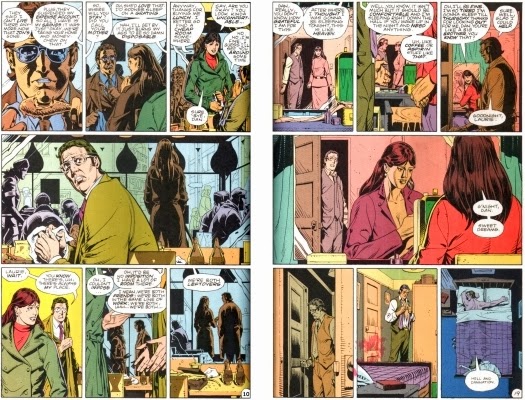
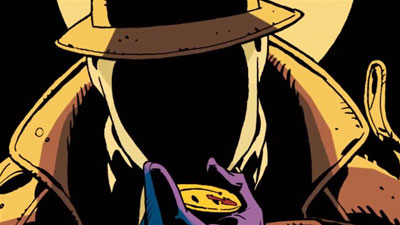
In Chapter 1 of Watchmen, Rorschach's Journal is used as a narrative device that serves two purposes: It gives us bearing on the world of Watchmen through Rorschach's unfiltered and harsh perspective and also characterizes Rorschach as a harsh, paranoid and stubborn character. Rorschach himself serves as a device, in this chapter, to introduce each of the other characters in the story by warning them of someone who is "picking off costumed heroes."
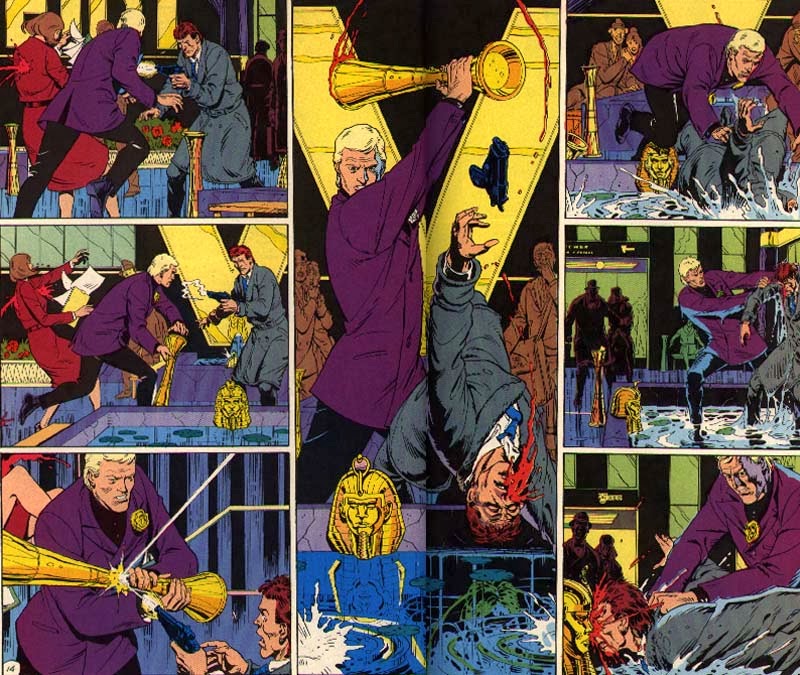
There are various visual motifs being employed immediately. One such motif is the flashbacks of Eddie Blake's attack and death that occur in a red filter, the only exception to the dominate red color scheme in these flashback panels is the smiley face that Blake is wearing. Throughout the first chapter there are various color schemes for different backgrounds as well as characters: Rorschach most often appears surrounded in browns and various dark colors, Daniel Dreiberg is surrounded by browns and yellows, Adrian Veidt is encompassed in a variety of purples, Dr. Manhattan and Laurie Juspeczyk appear with pale greens and purples. Each of these color schemes sets a certain tone for each interaction. For instance when Rorschach visits Veidt the two have a more straight-forward conversation than any other in the first chapter, a dignified conversation, dignity being a trait of royalty, of which purple is most often associated with. Of course, it could be argued that the purple is symbolic of Veidt's riches, or royalty.
The famous Watchmen symbol, the blood-stained smiley plays as important foreshadowing in the chapter. In the first chapter alone, I feel the smiley symbolizes former peace and happiness. When it becomes stained with blood during The Comedian's altercation with the unknown assailant, it represents events being set in motion that threaten to disturb the peace and happiness our characters are experiencing. When it pops up in the last seen of the chapter, the blood mark is gone whilst Laurie and Daniel have a nice, laughable conversation. Because the blood is no longer present, it represents peace and happiness again, characterized by the pair's comfort and happiness with each other.
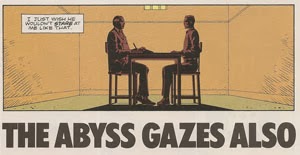
My favorite element in the book is the beginning of a popular quote being introduced at the start of the chapter, and then at the end of that chapter the quote is finished off wholly in a small panel. The quote serves to highlight the central theme of the chapter while simultaneously, grandiosely, instructing the reader to connect the dots, in terms of what occurred.
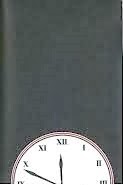
Two final elements of note are presented at the end of the chapter. The excerpt from the fictional novel "Under The Hood" of which was "written" by Hollis Mason, the former Nite Owl; this excerpt serves to provide further background on the setting of Watchmen. The other element of note, being the clock on the lastly page being both curiously and ominously close to midnight.
Chapter 2
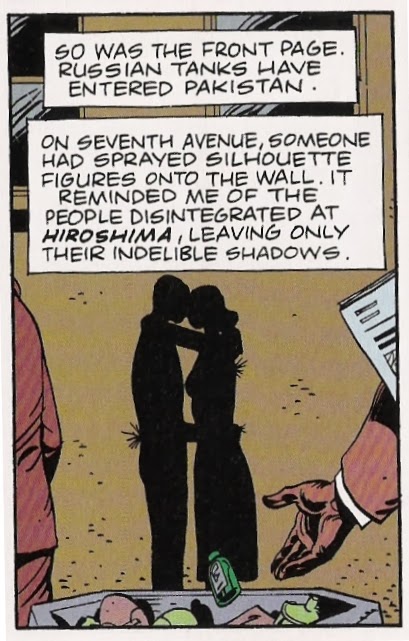
Immediately, in Chapter 2, we take note of patterns that can be found throughout the book. Firstly, The covers of each issue, as we have seen, are a close up of something in the first panel of the first page. It was first evident in Chapter 1, when we are given the Smiley on the ground surrounded by blood. Here we have the face of an angel statue in a cemetery, in the rain. In both instances it serves to give the reader a focus point for the issue and to immediately give a transition from the cover, to the story.
Another pattern we've seen and will continue to see, is the changing of the image of the clock on the last page that continues to tick towards midnight, but now includes, even more foreboding than the clock itself, blood. If that doesn't give a reader a sense of foreshadowing, I don't know what will.

A visual motif present in this issue is whenever there are two scenes occurring simultaneously, the panels alternate and, teaming with the 9-panel format littered throughout the book, create an 'X' type pattern; with one scene taking the form of the 'X' and the other taking the remaining panels. In a nearly identical fashion, whenever Moloch tells Rorschach of his encounter with The Comedian, all nine panels remain in the same scene but change color tone, thus creating the 'X' shape with the panels yet again.
As far as I am aware, the 'X' panel pages serve only an aesthetic purpose; merely symmetrically eye-pleasing.
Transitions in this chapter occur in a very interesting manner. There are nearly no simple scene changes in this chapter, most transitions are set-up with a visual aid: Often a character is taken and "flashbacked' to a point in time where we are looking at them in the same position but in a different time period, the transition take 2-3 panels. Another aid in scene transitions is the use of dialogue: like when transitioning between Laurie and her mother conversing, and The Comedian's funeral. Whenever we transition to and from the funeral, Laurie and/or her mother remarks of something thematically or visually relevant at the funeral.
Through the use of the flashback, we are able to characterize both The Comedian and the one experiencing the flashback. Interestingly, The Comedian exposes for the reader the pivotal character flaws in several characters, in their flashbacks to him: Ozymandias is deduced as the smartest man in a hopeless world ("...Then Ozzy here is gonna be the smartest man on the cinder."), Dr. Manhattan is made aware of his growing detachment to humanity (*Regarding Blake's outright murder of a pregnant woman, "You WATCHED me. You coulda changed the gun into steam or the bullets into mercury or the bottle into SNOWFLAKES! You coulda teleported either of us to Goddamn Australia... But you didn't lift a finger!") and The Comedian even has himself figured out in his flashback with Daniel, which is epitomized by the thought provoking exchange between the two: "What happened to the American Dream?" to which the Comedian responds, "It came true. You're looking at it."
These exchanges serve as a very grim reminder to us as we read through Watchmen: These are not typical, straightforward heroes; none of them are, in any fashion. These characters are all deeply flawed, and we've only begun to see them wholly.

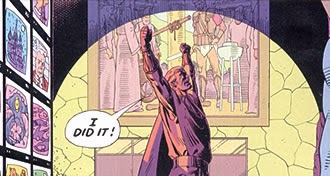 At last our journey is at an end with the characters of Watchmen. In Adrian Veidt's search for the answer to world peace, he has come up with a plan to slaughter millions to save billions; in turn turning violent attention from man's self to an imaginary foe. In concept Veidt's plan is perfect. No more war, no more conflict, it's all at an end. Veidt is, in the darkest possible way, the true "hero" of the earth. Our protagonists have made it all the way to Veidt, but failed to stop his plan, and, if they have any hope of this whole crusade being worth anything at all, must make a compromise: they must remain silent, or the world will return to a doomed fate of war.
 Except, there is only one person who has a problem with this: our dear, sugar-cube loving, ink-blot shifting detective, Rorschach. Rorschach will NOT compromise in justice, in response to the others' telling Rorschach that they must compromise, "Joking, of course... No. Not even in the face of Armageddon. Never Compromise." This really speaks volumes about the Rorschach character. In Rorschach's eyes, there can be no justice if there is to be any compromise. Things are black and white, there is good and there is evil, Rorschach would argue. Which, as I spoke of in chapters 5 and 6, is further attributed to his duality as a character. Things are only one way or the other. Most people would say that Rorschach is way to harsh, or that he is essentially crazy, that he's not a hero at all. But he is the only one willing to stand against the others and fight to let the truth be known. The only character to truly stand for justice. In my perspective, Rorschach is the "true hero" of Watchmen. Fittingly, the world of Watchmen has no place for a true hero...
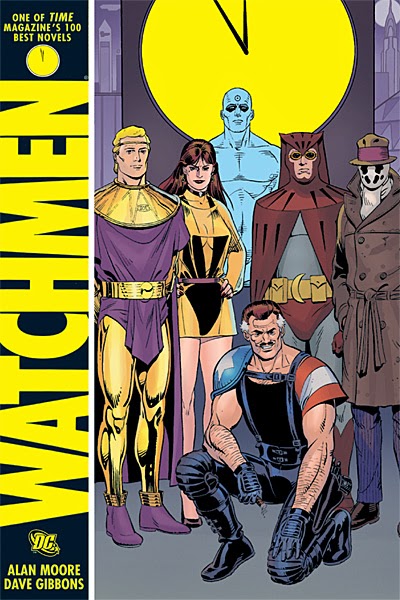 After Veidt's plan is fully completed , though, is when we are brought forth a profound, if not disturbing question: Who is/are the real heroes of this story? What defines a hero in general? One could assert that, even though he is the antagonist of the book, Adrian Veidt is the hero. He's saved billions of lives, and effectively ended war on earth. Sounds like a hero, right? If we follow this line of thinking we can boil it down to: Veidt was able to compromise justice to end injustice. This is the antithesis of Rorschach's line of thinking: He is unwilling to compromise in the pursuit of justice in anyway, no matter what the cost, evil must be punished. In a way one could look at any of the characters here and present them as the hero or the villain of the story.
 Watchmen breaks our 'heroes' apart and shows us what they are really made of: All powerful beings, who are ignorant and are careless towards humanity, smart, rich kids who are just in it for the thrill, masterful tacticians who are willing to put anything on the line to win, anarchists who see beyond the structures of society and simply don't care, and lastly, unflinching, uncompromising, enforcers of justice, who see only in shades of black and white. While on the surface they appear to be fantastic comic-book 'heroes', these characters are flawed beyond recognition and redefine what it means to be a "hero".